

The accident is over.
The bump on your head is gone. Maybe the scan was normal. You have gone back to work, school, driving, or everyday life.
By downloading the Digital Patient Chart mobile app you can better control your patient portal.


But something still feels different.
You stand up quickly and feel unsteady. Walking through a busy store feels strangely exhausting. Turning your head too fast produces a moment of dizziness. Reading takes more concentration than it used to.
Sometimes there is brain fog. Sometimes a headache.
And sometimes the hardest part is that everyone around you thinks you should be fine by now.
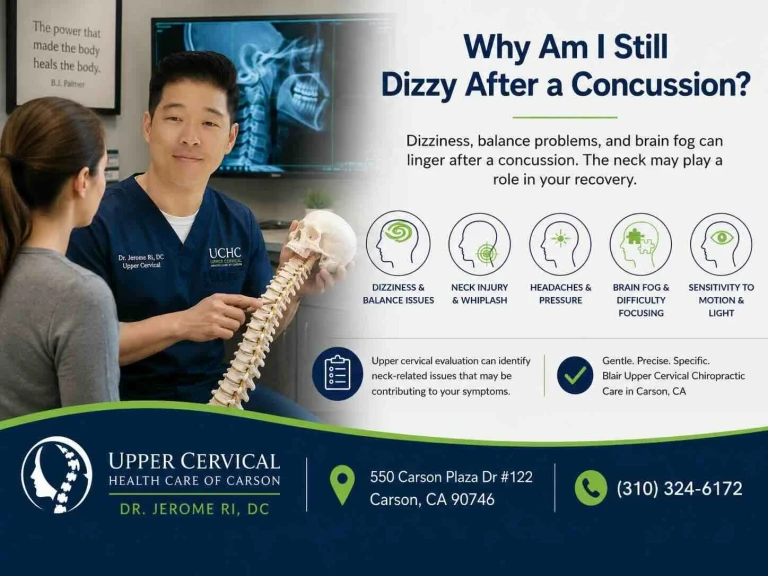
Persistent symptoms after a concussion are real, and dizziness is one of the complaints that can linger. The challenge is determining which system is producing the symptom.
What is a concussion?
A concussion is a mild traumatic brain injury, and dizziness, headaches, concentration problems, fatigue, visual symptoms, and balance difficulties may occur afterward. Most people improve, but some experience symptoms for weeks or months.
The important part is that dizziness after concussion does not always have one single cause.
It may involve the brain itself. It may involve the inner-ear balance system. Visual processing may be affected.
And in some patients, the cervical spine was injured at the same time.
That possibility is easy to overlook because the word concussion immediately directs attention toward the head.
The neck traveled through the impact too.
Why a Concussion Can Affect More Than the Brain
Consider what happens during a collision, fall, or sports impact.
The head accelerates or changes direction rapidly. The brain can move within the skull, but the muscles, joints, and ligaments supporting the head also have to absorb some of that force.
You can therefore have more than one problem after the same event.
A person may have a concussion accompanied by cervical strain. Another may develop vestibular dysfunction. Someone else may have a combination of cervical, visual, vestibular, and neurological symptoms.
That overlap helps explain why two people with the same diagnosis may have completely different recoveries.
One person mostly struggles with headaches.
Another says, “I feel like I’m walking on a boat.”
Another cannot tolerate computer screens.
Another feels almost normal until they turn their head quickly.
Related article
Upper Cervical Chiropractic for Migraine Relief: What Patients Should Know
Oct 13, 2025What Does Post-Concussion Dizziness Feel Like?
Not everyone describes it as spinning.
Patients may use words such as:
- Floating or swaying
- Off balance
- Lightheaded
- Unsteady when walking
- Dizzy when turning the head
- Overwhelmed in crowded stores
- Difficulty focusing while moving
- “Foggy” or disconnected
More symptomatic after driving or screen use
Those descriptions matter.
True spinning vertigo, lightheadedness, visual-motion sensitivity, and imbalance may point clinicians toward different systems.
Simply saying “dizziness” does not tell us enough.
What Recent Research Found About the Neck After Concussion
This is where a 2024 study becomes useful without making the issue more complicated than it needs to be.
Researchers studied people with a previous concussion who considered themselves nearly recovered. They compared them with people who had never experienced a concussion.
The post-concussion group still demonstrated differences in cervical joint mobility and neck sensorimotor control, even though their overall symptoms were relatively low.
That does not prove that the neck causes all persistent concussion symptoms.
It tells us something more practical:
A person can feel mostly recovered from a concussion and still have measurable cervical dysfunction.
For someone who continues to experience dizziness, headaches, balance difficulty, or symptoms triggered by head movement, the cervical spine therefore may be one area worth examining.
Why the Upper Cervical Region Gets Attention
The atlas and axis—C1 and C2—sit directly below the skull.
The muscles and joints in this region contain sensory receptors that help the nervous system determine where the head is positioned.
That information has to coordinate with your eyes and vestibular system.
Think of the brain receiving three reports:
Eyes: “Here is what I see.”
Inner ear: “Here is how the head is moving.”
Neck: “Here is where the head is positioned.”
Normally, those messages agree.
Following an injury, however, one system may provide information that does not match the others perfectly. That sensory mismatch is one reason cervical function is considered during some concussion evaluations.
It is also why simply calling every post-concussion balance complaint “vertigo” can miss important details.

A Familiar Scenario
Imagine someone in Carson who was rear-ended several months ago.
The emergency evaluation found no major injury. The headaches gradually improved. The person returned to work.
Yet driving remains uncomfortable.
Checking the side mirror requires turning the head, and that movement brings on an odd wave of disequilibrium. By late afternoon, the base of the skull feels tight. Walking through a brightly lit store makes the head feel overloaded.
The obvious assumption is that all of those symptoms are still coming from the concussion.
Maybe they are.
But a useful examination asks another question:
Did the neck sustain an injury during the same collision?
Finding a cervical component does not erase the concussion diagnosis. It may simply identify another system that needs attention.
Where Upper Cervical Chiropractic Fits
Upper Cervical Health Care of Carson uses the Blair Upper Cervical Chiropractic Technique.
Dr. Jerome Ri has specialized in Blair Upper Cervical care for more than 16 years. The technique focuses on the individual anatomy of the upper cervical joints and, according to the practice, avoids traditional pulling, popping, or twisting of the neck.
The first visit includes a detailed history of current symptoms and previous trauma, followed by examination and objective testing. When appropriate, the practice uses precision imaging of the upper cervical joints to study individual anatomy and determine whether a correction is indicated.
For a patient with persistent symptoms after concussion, Dr. Ri may want to know:
When did the dizziness begin?
Was there also whiplash?
Does moving the neck reproduce the symptom?
Are headaches present at the base of the skull?
Is neck rotation restricted?
Does the patient experience true spinning, or more of a swaying sensation?
Are there visual symptoms?
Those details help determine whether a cervical component may be present.
Upper Cervical Care Is Not Concussion Treatment

This distinction is important.
A concussion is a brain injury.
An upper cervical adjustment should not be presented as a treatment that “fixes the brain” or cures a concussion.
The potential role of upper cervical care is to evaluate and address a coexisting mechanical problem in the cervical spine when one is found.
Some patients may also require a neurologist, sports-medicine physician, vestibular therapist, physical therapist, vision specialist, or another healthcare professional.
Post-concussion recovery is often a multi-system problem. There is no reason every part of that recovery has to come from one office.
When You Need Medical Care First
New concussion symptoms should receive appropriate medical evaluation, particularly after a recent head injury.
Emergency care is needed for warning signs such as a worsening headache that does not go away, repeated vomiting, seizures, increasing confusion, unusual behavior, slurred speech, weakness or numbness, poor coordination, increasing drowsiness or inability to wake, or one pupil becoming larger than the other.
Upper cervical evaluation belongs after urgent neurological problems have been addressed, not instead of them.
Frequently Asked Questions
1. How long can dizziness last after a concussion?
Many concussion symptoms improve within days or weeks, but some people experience persistent symptoms for months. Persistent post-concussive symptoms may include dizziness, headaches, fatigue, concentration problems, sleep changes, and visual complaints.
2. Can my neck cause dizziness after a concussion?
The cervical spine can contribute to dizziness or balance symptoms in some patients. A 2024 study found persistent cervical mobility and sensorimotor deficits in people with previous concussion, but an examination is needed to determine whether the neck is relevant in an individual case.
3. Why does turning my head make me dizzy?
Head turning simultaneously challenges cervical position sensing, vision, and the vestibular system. Symptoms triggered consistently by neck movement provide useful information but do not establish a diagnosis on their own.
4. Will an upper cervical adjustment cure post-concussion syndrome?
No treatment should be promised as a cure. Upper cervical care may address a cervical mechanical component that accompanies the concussion, while other symptoms may require neurological, vestibular, visual, or rehabilitative care.
5. Can I have a neck injury without severe neck pain?
Yes. Cervical dysfunction is not always experienced as strong pain. The 2024 research found cervical sensorimotor and mobility differences even among people who were relatively low in post-concussion symptoms.
Post-Concussion Evaluation in Carson, CA
One of the frustrating parts of concussion recovery is hearing, “Everything looks normal.”
Normal imaging can be reassuring.
But it does not automatically explain why turning your head still makes you feel off balance, why headaches continue, or why an ordinary trip through a grocery store now feels strangely demanding.
Sometimes recovery requires looking at more than one system.
For patients whose persistent post-concussion symptoms occur alongside restricted head movement, skull-base headaches, a history of whiplash, or dizziness that changes with neck motion, evaluating the upper cervical spine may provide another useful piece of the picture.
Upper Cervical Health Care of Carson
Dr. Jerome Ri, DC
550 Carson Plaza Dr #122
Carson, CA 90746
Phone: (310) 324-6172
The practice provides Blair Upper Cervical Chiropractic care for patients in Carson and surrounding South Bay communities.
Medical note: A concussion is a brain injury. Upper cervical chiropractic does not replace medical concussion evaluation or neurological care. New, severe, or worsening symptoms following head trauma require prompt medical assessment.

Leave a comment