


You reach into the top kitchen cabinet.
Before your hand finds what you want, your arm starts tingling.
By downloading the Digital Patient Chart mobile app you can better control your patient portal.


You lower it.
The sensation fades.
Maybe the same thing happens while blow-drying your hair, working overhead, lifting at the gym, or reaching repeatedly during a shift.
After a while, you start keeping that arm lower without even thinking about it.
That particular pattern deserves more attention than simply calling it “poor circulation.”
What Is Thoracic Outlet Syndrome?
The thoracic outlet is the narrow region between the collarbone and first rib where nerves and blood vessels travel toward the arm.
Thoracic outlet syndrome, or TOS, occurs when one or more of those structures becomes compressed.
The most common form is neurogenic thoracic outlet syndrome, involving the brachial plexus—the network of nerves that supplies the shoulder, arm, and hand.
Symptoms often become more noticeable when the arm is lifted.
What It Can Feel Like
A patient may describe:
- Numbness or tingling in the arm or fingers
- Aching in the shoulder, arm, or hand
- Weakness or quick fatigue with overhead activity
- A heavy feeling in the arm
- Symptoms that increase when reaching upward
Related article

Upper Cervical Chiropractic Near Me: A Comprehensive Guide to Natural Healing
Oct 27, 2025This can resemble cervical radiculopathy, carpal tunnel syndrome, ulnar nerve compression, or shoulder disease.
That overlap is one reason TOS is sometimes difficult to diagnose.
What 2024 Research Says
A 2024 comprehensive review described neurogenic TOS as a challenging diagnosis because symptoms overlap with several other neurological and musculoskeletal conditions.
The review emphasized that compression may occur in several places—including the scalene triangle, costoclavicular space, and beneath the pectoralis minor—and that repetitive overhead activity and anatomical variations can contribute.
That is important for patients.
There is no single “thoracic outlet adjustment.”
The clinician first has to determine whether TOS is even the correct diagnosis.
Why South Bay Patients May Notice the Pattern
Carson and the surrounding South Bay are full of jobs and activities that place the arms in repeated positions.
- Warehouse work
- Mechanic work
- Hair styling
- Weight training
- Construction
Hours at a computer with the shoulders drifting forward.
One motion does not automatically produce thoracic outlet syndrome. But repeated stress, previous trauma, and individual anatomy can change how much room the nerves and vessels have.
Posture Can Influence the Space
That does not mean posture is a disease.
Related article
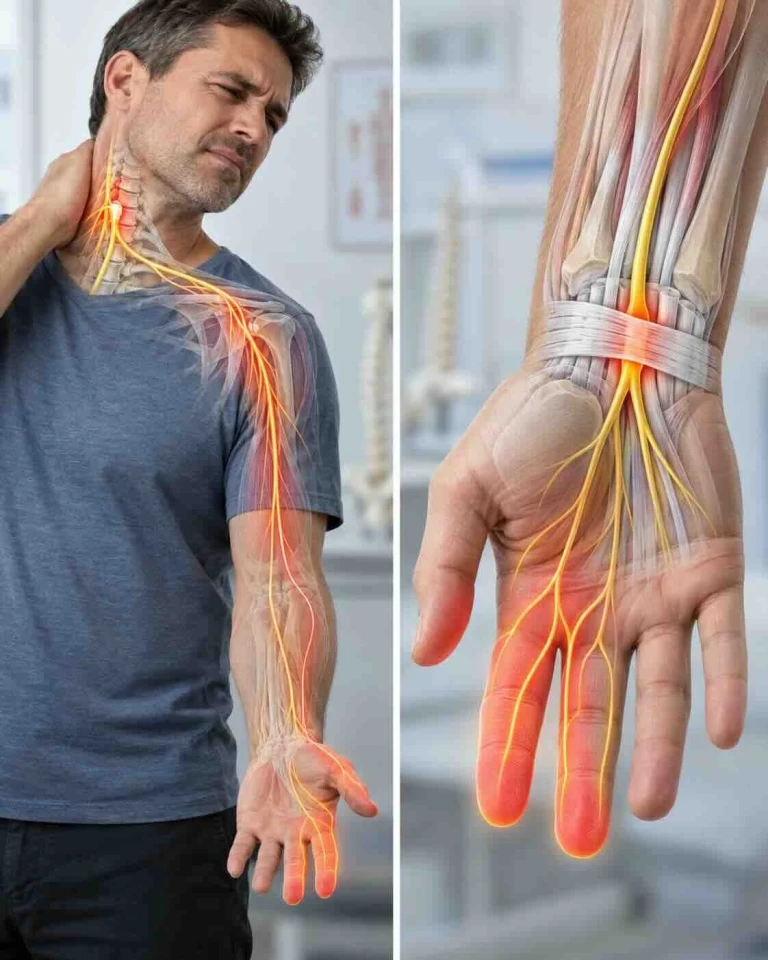
Pinched Nerve in Neck vs. Carpal Tunnel: Why Your Hand Numbness Might Not Be a Wrist Problem
Sep 12, 2026Bodies move.
But if the shoulder girdle repeatedly collapses forward and the head lives several inches in front of the torso, some tissues have to work differently.
For a person whose thoracic outlet is already sensitive, that mechanical environment can matter.
Where Upper Cervical Care Fits
Upper Cervical Health Care of Carson uses the Blair Upper Cervical technique with Dr. Jerome Ri.
The upper cervical region is not the thoracic outlet.
C1 and C2 do not directly sit between the collarbone and first rib.
The possible relevance is through the larger postural system.
If the head is persistently tilted or shifted, the shoulders and upper thoracic spine may compensate. If the shoulder girdle is already part of a TOS pattern, evaluating the head-neck relationship can be reasonable.
That is very different from saying an atlas adjustment “treats TOS.”
Dr. Ri’s Blair approach focuses on individualized upper cervical analysis and avoids forceful pulling, popping, or twisting.
Neurogenic Versus Vascular TOS
This distinction is essential.
Neurogenic TOS affects nerves.
Venous and arterial TOS affect blood vessels and can be much more urgent.
Sudden arm swelling, blue or purple discoloration, a very cold hand, a weak pulse, severe hand pain, or unusual color changes should not be treated as ordinary muscle tension.

Frequently Asked Questions
1. Why does my hand tingle when I raise my arm?
Thoracic outlet compression is one possibility, but cervical nerves, peripheral nerve entrapment, and shoulder conditions can produce similar symptoms.
2. Which fingers are affected?
Neurogenic TOS often produces symptoms toward the ring and little fingers, but patterns vary.
3. Can a car accident contribute?
Yes. Trauma can change tissues around the thoracic outlet and may contribute to compression in some patients.
4. Can Blair Upper Cervical chiropractic cure thoracic outlet syndrome?
No cure should be promised. Upper cervical evaluation may identify postural compensation that coexists with TOS, while direct management may require rehabilitation, medical testing, vascular evaluation, or surgery.
Thoracic Outlet Evaluation in Carson
If your hand only goes numb when your arm is overhead, the pattern is giving you information.
The question is where the pathway is being compressed.
At the neck?
At the shoulder?
At the thoracic outlet?
Farther down the arm?
Finding the location matters more than chasing the numbness.
Upper Cervical Health Care of Carson
Dr. Jerome Ri, DC
550 Carson Plaza Dr #122
Carson, CA 90746
Phone: (310) 324-6172
Medical note: Sudden arm swelling, discoloration, loss of pulse, or a cold painful hand requires urgent medical evaluation.


Leave a comment