


Taking a deep breath is something most people never think about, until it suddenly causes discomfort. A sharp sensation in the back during inhalation can feel alarming. Many people assume the pain must be coming from the lungs, ribs, or muscles in the chest.
However, in many cases, the source of this discomfort is actually related to spinal mechanics, muscle tension, or nerve irritation that influences how the rib cage moves during breathing.
By downloading the Digital Patient Chart mobile app you can better control your patient portal.


Understanding why back pain can occur during deep breathing requires looking at the relationship between the spine, the rib cage, and the nervous system. In some cases, the issue may even begin higher in the spine, particularly in the upper cervical region.
This article explains why breathing can trigger back pain, the structures involved, and how upper cervical chiropractic care may play a role in restoring proper function.
How Breathing Involves the Spine
Breathing is not only a lung function, it is also a mechanical movement involving the spine, ribs, diaphragm, and surrounding muscles.
Every deep breath causes the rib cage to expand and rotate slightly. This movement requires coordination between:
- The thoracic spine (mid-back)
- The rib joints
- The intercostal muscles
- The diaphragm
- The nervous system controls these structures
When these structures move normally, breathing feels effortless.
However, if any part of this system becomes restricted, irritated, or misaligned, deep breathing can trigger discomfort in the back.
Common areas where people feel pain during deep breathing include:
- Between the shoulder blades
- Along one side of the mid-back
- Near the ribs
- Around the upper back and neck
The location of the pain often gives clues about what structures may be involved.
Common Causes of Back Pain During Deep Breathing
Several musculoskeletal conditions can contribute to pain when taking a deep breath.
1. Rib Joint Dysfunction
Each rib connects to the spine through small joints. These joints must glide slightly as the rib cage expands during inhalation.
If a rib joint becomes restricted or irritated, breathing deeply can create a sharp or pulling sensation in the back.
People often notice this pain when:
- Taking a deep breath
- Twisting the torso
- Coughing or sneezing
Rib joint irritation is commonly mistaken for muscle strain or lung problems.
2. Thoracic Spine Stiffness
The thoracic spine plays a key role in breathing mechanics.

Poor posture, prolonged sitting, or repetitive strain can reduce mobility in this region. When the thoracic spine becomes stiff, the ribs cannot move normally during breathing.
As a result, surrounding muscles compensate and become tight or irritated.
This can create symptoms such as:
- Pain between the shoulder blades
- Tightness when inhaling deeply
- Limited chest expansion
3. Muscle Tension Around the Rib Cage
Muscles involved in breathing include:
- Intercostal muscles (between the ribs)
- Scalenes in the neck
- Serratus muscles around the ribs
- Diaphragm and accessory breathing muscles
When these muscles become overworked or strained, breathing can trigger discomfort.
Athletes, individuals with poor posture, or those under prolonged stress frequently develop excessive tension in these muscles.
4. Irritation of Thoracic Nerves
Nerves exiting the thoracic spine travel along the ribs.
If these nerves become irritated due to spinal joint restriction or muscle tightness, breathing can trigger pain along the nerve pathway.
People may describe:
- Sharp stabbing sensations
- Pain wrapping around the rib cage
- Increased discomfort during deep breathing
The Overlooked Role of the Upper Cervical Spine
While many breathing-related back problems occur in the mid-back, an important contributor is often overlooked: the upper cervical spine.
The upper cervical region consists primarily of two vertebrae:
- Atlas (C1)
- Axis (C2)
These vertebrae support the skull and protect the brainstem, a critical area responsible for communication between the brain and the rest of the body.
Because the brainstem regulates breathing patterns and muscle tone, disruptions in this region can influence how the entire spine and rib cage function.
How Upper Cervical Misalignment Can Affect Breathing Mechanics
When the atlas or axis becomes misaligned, subtle changes in posture and muscle balance can occur throughout the spine.
This may lead to:

- Compensatory tension in the neck and upper back
- Altered breathing patterns
- Increased strain on thoracic muscles
- Reduced rib mobility
Over time, these compensations can create discomfort in the back during deep breathing.
In other words, the pain felt in the mid-back may be the result of a chain reaction starting higher in the spine.
Posture, Head Position, and Breathing
Head posture has a direct influence on breathing mechanics.
Forward head posture, common among people who work at desks or use phones frequently, changes how the rib cage and diaphragm function.
When the head shifts forward:
- Neck muscles tighten
- Upper back muscles become overworked
- The rib cage may become less mobile
This can lead to shallow breathing and tension that becomes noticeable when attempting a deep breath.
Upper cervical alignment plays a major role in maintaining balanced head posture.
Signs the Spine May Be Contributing to Your Breathing Pain
Back pain during breathing may be related to spinal mechanics when symptoms include:
- Pain that increases with deep inhalation
- Discomfort between the shoulder blades
- Pain when twisting the torso
- Stiffness in the upper back or neck
- Head or neck tension accompanying the back pain
If these symptoms appear alongside posture changes or chronic neck tension, spinal involvement becomes more likely.
How Upper Cervical Chiropractic Care May Help
Upper cervical chiropractic care focuses specifically on the alignment of the atlas and axis.
Rather than applying forceful twisting adjustments, upper cervical techniques typically use precise and gentle corrections based on detailed imaging and measurements.
The goal is to restore balance at the top of the spine, allowing the nervous system and spinal mechanics to function more efficiently.
When alignment improves, patients may experience:
- Reduced muscle tension in the neck and upper back
- Improved posture
- Better spinal mobility
- More natural breathing mechanics
Because the spine functions as a connected system, improving the foundation at the top often influences the rest of the spinal chain.
Related article
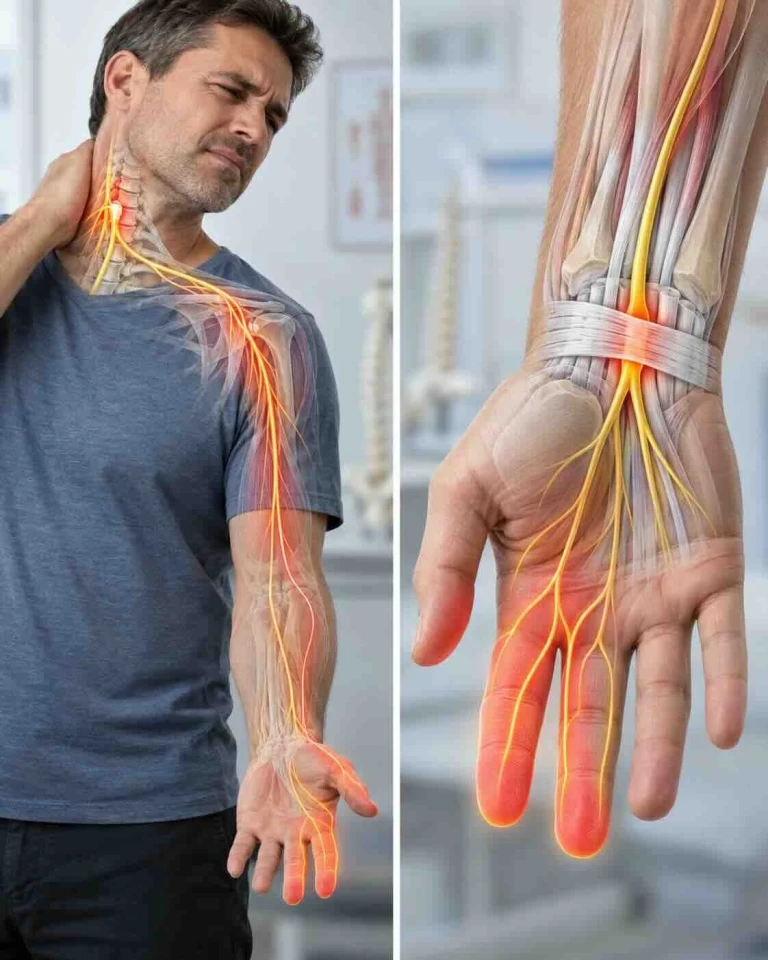
Pinched Nerve in Neck vs. Carpal Tunnel: Why Your Hand Numbness Might Not Be a Wrist Problem
Sep 12, 2026When to Seek Professional Evaluation
Back pain during deep breathing is often musculoskeletal, but it should always be evaluated if it persists or worsens.
Professional assessment may be appropriate if symptoms include:
- Persistent pain lasting more than several days
- Pain spreading into the chest or ribs
- Difficulty breathing normally
- Pain after injury or trauma
- Recurring episodes of breathing-related back pain
The Bigger Picture: Breathing, Posture, and Spinal Health
Breathing may seem simple, but it reflects the complex coordination of the entire musculoskeletal and nervous systems.
The rib cage, spine, muscles, and nervous system must all work together to allow smooth and comfortable breathing.
When any link in this chain becomes restricted or imbalanced, especially in the upper cervical region, symptoms can appear in unexpected places, including the mid-back.
Understanding this connection helps explain why some cases of breathing-related back pain do not respond fully to stretching or local treatment alone.
Addressing spinal alignment and nervous system balance can sometimes reveal the underlying cause.
When Breathing Should Feel Easy Again
If taking a deep breath triggers discomfort in your back, it may be a signal that something in the spine or surrounding muscles is not functioning the way it should.
While many people focus only on the area where the pain is felt, the underlying cause can sometimes originate higher in the spine, particularly in the upper cervical region.
At our practice, the focus is on understanding how the spine, nervous system, and posture interact.
Through a detailed evaluation of spinal alignment, movement patterns, and upper cervical balance, it becomes possible to identify factors that may be contributing to symptoms such as upper back tension, rib discomfort, neck tightness, or pain during deep breathing.
Many individuals seek care after trying stretches, massage, or short-term treatments that provide only temporary relief. A closer look at the upper cervical spine may reveal mechanical patterns that affect how the rest of the spine and rib cage move.
If you have been experiencing:
- Back pain when taking a deep breath
- Tightness between the shoulder blades
- Neck tension or head pressure
- Rib discomfort when twisting or inhaling
- Postural strain from desk work
An evaluation may help clarify what is contributing to those symptoms.
A consultation allows the doctor to review your health history, assess spinal mechanics, and determine whether upper cervical care may be appropriate for your situation.
Breathing is something the body is designed to do effortlessly. When the spine and nervous system function in balance, many everyday movements, including deep breathing, often become more comfortable again.
If these symptoms sound familiar, contacting the practice to schedule an evaluation can be the first step toward understanding what your body may be trying to tell you.


Leave a comment