

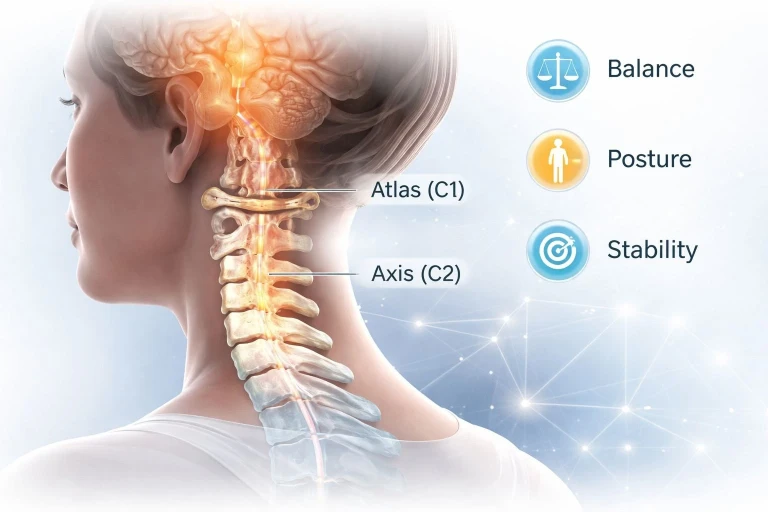
The atlas and axis may be small, but their influence on the body is significant. These first two vertebrae at the top of the neck help support the head, guide movement, and play a major role in balance, posture, and stability.
When they function well, the body can coordinate movement more efficiently. When they are under abnormal stress or misaligned, subtle changes can affect how a person feels, moves, and maintains control.
By downloading the Digital Patient Chart mobile app you can better control your patient portal.


For upper cervical chiropractic, the atlas and axis are especially important because of their close relationship to the brainstem, spinal cord, head position, and the body’s postural control system.
Understanding their role helps explain why problems in this region may contribute to dizziness, neck tension, poor posture, and a general sense of instability.
What are the atlas and axis?
The atlas is the first cervical vertebra, also called C1. It supports the skull and allows the head to balance on top of the spine. The axis is the second cervical vertebra, or C2. It works closely with the atlas to allow rotation of the head.
Together, these two vertebrae create the most mobile segment in the spine. They allow you to turn your head, nod, and keep your eyes level with the horizon. This mobility is essential, but it also means the area depends on precise alignment and control.
Unlike other spinal segments, the atlas and axis are uniquely shaped for movement and neurological importance rather than weight-bearing strength. That is why even small positional changes in this region may have a larger effect than people expect.
Why the upper cervical spine matters for balance
Balance is not controlled by one body part alone. It depends on constant communication between the brain, inner ears, eyes, muscles, joints, and nervous system. The upper cervical spine is deeply involved in that process.
The muscles and joints around the atlas and axis contain a high concentration of proprioceptors. These are sensory receptors that tell the brain where the head and neck are positioned in space. This input helps the brain coordinate posture, eye movement, and equilibrium.
When the atlas and axis move properly, that sensory information tends to be more accurate. When the area is irritated, restricted, or under abnormal mechanical stress, the information sent to the brain may become less efficient. This can interfere with how the body interprets position and movement.
That is one reason some people with upper cervical dysfunction report symptoms such as:
- poor balance
- a heavy or tilted head sensation
- dizziness or unsteadiness
- tension in the neck and shoulders
- posture that feels difficult to maintain
- a sense that the body is compensating unevenly
These symptoms do not always begin dramatically. In many cases, they build gradually as the body adapts to altered mechanics over time.
Related article

Upper Cervical Chiropractic for Migraine Relief: What Patients Should Know
Oct 13, 2025The atlas and axis influence posture from the top down
Posture is not only about sitting up straight. It is about how the body organizes itself against gravity.
Since the atlas supports the head, and the axis helps direct head movement, both vertebrae influence how the rest of the spine responds.
The head weighs a considerable amount, and its position matters. If the atlas and axis are not functioning well, the head may shift slightly forward, tilt, or rotate. Once that happens, the body often compensates below.
This can lead to patterns such as:
- forward head posture
- uneven shoulder height
- muscle tension through the neck and upper back
- altered spinal curves
- imbalance in weight distribution while standing
- compensations into the pelvis or lower body
The body is always trying to keep the eyes level and maintain an upright position. If the top of the spine is not stable, the rest of the body may work harder to adapt. Over time, this can reduce efficiency and create chronic strain.
Stability begins with head and neck control
Stability is the body’s ability to maintain control during movement and at rest. It depends on alignment, muscular support, neurological communication, and coordination between body regions.
The atlas and axis contribute to stability because they help orient the head correctly over the spine. The head is the body’s most important reference point for movement.
If its position is off, even slightly, the nervous system may trigger compensations to protect balance and maintain function.
That can affect how a person stands, walks, turns, bends, and even how they tolerate daily physical stress.
In some individuals, upper cervical instability or dysfunction may contribute to movement patterns that feel less smooth or less secure.
This becomes especially important for people who have experienced:
- whiplash or head trauma
- repeated falls
- chronic neck stress
- prolonged screen use
- posture-related strain
- recurring tension headaches or dizziness
These stressors may change how the upper cervical spine moves and how the body stabilizes around it.

The neurological connection
One of the main reasons upper cervical care receives so much attention is the neurological importance of the atlas-axis region.
This area sits near the brainstem, which helps regulate communication between the brain and body. It also plays a role in coordination, muscle tone, postural reflexes, and autonomic function.
The goal is not to overstate what one spinal segment can do, but rather to understand that structure and function are connected.
If the atlas and axis are under ongoing stress, they may influence how efficiently the nervous system processes positional input and maintains control.
That is why upper cervical evaluation often focuses on precision. The concern is not only neck pain. It is whether the relationship between the head, spine, and nervous system is as stable and balanced as it should be.
Why this matters in daily life
When people think of the neck, they often think only of pain or stiffness. But the upper neck affects much more than comfort. It influences how confidently a person moves through daily life.
A well-functioning atlas and axis can support:
- better head positioning
- more efficient balance control
- improved postural coordination
- smoother movement patterns
- less compensation through the spine and muscles
- greater sense of physical stability
For people with upper cervical issues, restoring better alignment and mechanics may help reduce the strain that contributes to instability and poor posture patterns.
An upper cervical perspective
Upper cervical chiropractic focuses on the relationship between the atlas, axis, and nervous system. Rather than using broad spinal approaches, this method often emphasizes detailed assessment and precise correction based on the individual.
The aim is to reduce abnormal stress in the upper cervical spine so the body can function with better structural and neurological efficiency.
Because the area is so important to head position and postural control, small corrections may have meaningful effects on how the body organizes itself.

This approach is often considered by people looking for answers related to:
- posture changes
- chronic neck tension
- recurring dizziness
- feelings of imbalance
- head and neck coordination issues
- long-term upper cervical stress
FAQ: Atlas and Axis, Balance, Posture, and Stability
1. What do the atlas and axis do?
The atlas and axis are the first two vertebrae in the neck. They support the skull, allow head movement, and help the brain interpret head position for balance and posture.
2. Can the atlas and axis affect balance?
They can influence balance because they contain important receptors that send positional information to the brain. When this area is not functioning well, balance and coordination may be affected.
3. How do the atlas and axis affect posture?
Since they control head position at the top of the spine, they influence how the rest of the body compensates below. Poor upper cervical alignment may contribute to forward head posture and uneven body mechanics.
4. Why is upper cervical care focused on C1 and C2?
C1 and C2 are highly mobile, neurologically important, and closely related to head position, coordination, and spinal balance. That makes them a major focus in upper cervical chiropractic.
Final Thoughts
Balance, posture, and stability depend on constant communication between the brain and body, and the atlas and axis are central to that process. When this area is functioning well, the body is better able to adapt, coordinate, and hold itself efficiently against gravity. When it is not, subtle imbalances may begin to affect how you feel and move.
At Upper Cervical LA, care is centered on the precise alignment of the upper cervical spine using a gentle Blair technique approach.
If you are in Carson, the South Bay, or the Greater Los Angeles area and want to explore whether upper cervical stress may be affecting your posture or stability, the team at Upper Cervical LA offers evaluations and care designed around that goal.
References
Kaiser JT, et al. Anatomy, Head and Neck: Cervical Vertebrae. StatPearls. NCBI Bookshelf.
Rahman S, et al. Anatomy, Head and Neck: Cervical Spine. StatPearls. NCBI Bookshelf.
Li Y, et al. Proprioceptive Cervicogenic Dizziness: A Narrative Review of Pathogenesis, Diagnosis, and Treatment.
Sung YH, et al. Upper cervical spine dysfunction and dizziness.
Kristjansson E, Treleaven J. Sensorimotor function and dizziness in neck pain.


Leave a comment