

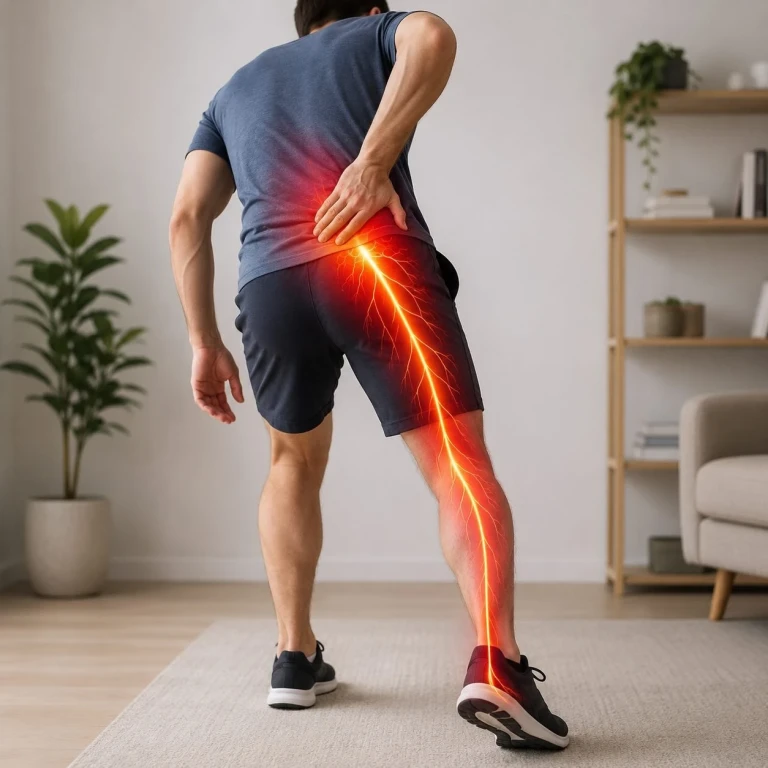
Radiating leg pain can feel confusing because the problem does not always begin where the pain is felt. A person may feel burning, tingling, numbness, weakness, or sharp pain traveling into the buttock, thigh, calf, foot, or toes.
In many cases, this type of pain is connected to nerve irritation, often from the lower back or pelvis, but the full picture can involve posture, spinal mechanics, muscle tension, and how the nervous system is functioning as a whole.
By downloading the Digital Patient Chart mobile app you can better control your patient portal.


For many patients, the common word used for radiating leg pain is sciatica. Sciatica describes pain related to irritation or compression of the sciatic nerve, which can cause symptoms in the low back, buttock, and leg.
But not every case of radiating leg pain is the same. Understanding the pattern matters.
What Is Radiating Leg Pain?
Radiating leg pain means pain travels from one area into another. Instead of staying in the low back or hip, the discomfort may move down the leg.
Some patients describe it as electric, shooting, burning, pulling, or deep aching. Others notice numbness, pins and needles, or weakness.
This type of pain may be connected to radiculopathy, which happens when a spinal nerve root becomes irritated or compressed.
Common Nerve Irritation Patterns
Nerves follow pathways. That is why symptoms often show up in recognizable patterns. While every patient is different, certain nerve roots are commonly associated with specific areas of discomfort.
L4 nerve irritation may cause symptoms toward the front of the thigh, knee, or inner lower leg. Some patients may notice difficulty with knee strength or changes in reflexes.
L5 nerve irritation may cause pain or tingling down the outside of the leg and into the top of the foot or big toe. Some patients may notice weakness when lifting the foot or big toe.
S1 nerve irritation may cause symptoms down the back of the leg, calf, heel, or outer foot. Some patients may notice changes in calf strength or ankle reflexes.
These patterns can help a healthcare provider better understand which nerve pathway may be involved. However, leg pain can also come from hip problems, sacroiliac joint irritation, muscle tension, vascular issues, peripheral neuropathy, or other conditions. That is why an exam matters.

Why Nerves Become Irritated
Nerve irritation does not always mean a nerve is permanently damaged. In many cases, the nerve is sensitive because of pressure, inflammation, poor movement mechanics, or repeated stress.
Common contributors may include:
- Herniated or bulging discs
- Degenerative disc changes
- Spinal stenosis
- Inflammation around a nerve root
- Poor posture and prolonged sitting
- Pelvic imbalance
- Muscle guarding in the low back, hips, or glutes
- Repetitive lifting or twisting
- Compensation from old injuries
Symptoms That May Point to Nerve Involvement
Radiating leg pain may involve more than pain alone. Patients often report:
- Pain traveling from the low back or buttock into the leg
- Burning, tingling, or numbness
- Pain that worsens with sitting, bending, coughing, or sneezing
- Pain that improves when changing positions
- Weakness in the leg, foot, or toes
- A heavy or unstable feeling while walking
- Symptoms that follow a line or pathway down the leg
The straight leg raise test is one clinical tool used to assess nerve root irritation in the low back and pelvis area.
When Radiating Leg Pain Should Be Evaluated Promptly
Some symptoms need immediate medical attention. Seek urgent care if leg pain is associated with loss of bowel or bladder control, numbness in the groin or saddle area, sudden severe weakness, fever, unexplained weight loss, trauma, or rapidly worsening symptoms.
For less urgent cases, a professional evaluation is still important when pain keeps returning, travels below the knee, causes numbness or weakness, or interferes with walking, sleeping, working, or daily activity.
How Upper Cervical Chiropractic Relates to Leg Pain
At first, upper cervical chiropractic may seem unrelated to radiating leg pain because upper cervical care focuses on the top of the neck: the atlas and axis, also known as C1 and C2.

But the spine does not function as isolated parts. The upper neck plays an important role in head position, posture, balance, and nervous system communication.
When the head and neck are not balanced well over the spine, the body may compensate through the shoulders, mid-back, low back, pelvis, hips, and legs.
Upper cervical chiropractic does not claim that every case of leg pain comes from the neck. Many cases of radiating leg pain involve the lumbar spine, pelvis, discs, or local nerve irritation.
However, upper cervical alignment may influence the way the body carries weight, coordinates posture, and manages tension through the spine.
A review on craniocervical chiropractic procedures explains that upper cervical approaches focus on the atlas region and discuss possible nervous system and postural effects related to altered mechanics at the upper cervical joints.
Another study on chiropractic atlas care reported neck pain and disability outcomes after upper cervical chiropractic care, though this type of research should be interpreted carefully and does not mean every condition responds the same way.
In an upper cervical chiropractic office, the goal is to look at the body as a connected system. When appropriate, the doctor may evaluate posture, spinal balance, neurological signs, gait, muscle tension, and how the upper neck may be contributing to compensation patterns.
Why a Full Evaluation Matters
Radiating leg pain should not be reduced to one label. “Sciatica” may describe the symptom, but it does not always explain the cause.
A careful evaluation may include:
- Health history
- Postural assessment
- Range of motion testing
- Orthopedic and neurological testing
- Reflex, strength, and sensation checks
- Gait and balance observation
- Imaging referral when clinically necessary
The goal is to understand whether the symptoms appear to be coming from the lumbar spine, pelvis, hip, peripheral nerve, or another source. From there, care can be more specific.
Upper cervical chiropractic may be part of a broader conservative approach when spinal balance, posture, and nervous system function appear to be involved. The focus is not only on chasing pain, but on understanding why the body is irritated and what patterns may be keeping symptoms active.
A Patient-Friendly Way to Think About It

Radiating leg pain is often a signal. The pain may be felt in the leg, but the irritation may be coming from a nerve pathway, spinal joint, disc, muscle tension pattern, or compensation somewhere else in the body.
The question is not only, “Where does it hurt?”
A better question is:
What is irritating the nerve, and why is the body loading that area this way?
That is where a detailed chiropractic and upper cervical evaluation can help.
Visit Our Upper Cervical Chiropractic Office
Radiating leg pain, sciatica-like symptoms, numbness, tingling, or recurring nerve irritation can affect how you walk, sit, sleep, and move through your day. You do not have to guess where it is coming from.
Our upper cervical chiropractic office evaluates the spine, posture, nervous system patterns, and body mechanics to better understand what may be contributing to your symptoms. We focus on gentle, specific care designed to support better alignment, better movement, and a more balanced nervous system.
Schedule a visit with our office to see whether upper cervical chiropractic care may be appropriate for your case.
FAQ
1. What causes radiating leg pain?
Radiating leg pain may be caused by irritation or compression of spinal nerve roots, sciatic nerve irritation, disc problems, spinal stenosis, muscle tension, pelvic imbalance, or other medical conditions.
2. Is radiating leg pain always sciatica?
No. Sciatica is one common cause, but radiating leg pain can also come from lumbar radiculopathy, hip problems, sacroiliac joint irritation, peripheral nerve issues, or other conditions.
3. Can upper cervical chiropractic help with leg pain?
Upper cervical chiropractic does not treat every case of leg pain directly. It evaluates whether upper neck alignment, posture, spinal balance, and nervous system function may be contributing to compensation patterns that affect the lower body.
4. When should I seek care for radiating leg pain?
Seek urgent care for bowel or bladder changes, saddle numbness, sudden weakness, fever, trauma, or rapidly worsening symptoms. Schedule an evaluation when pain persists, travels down the leg, causes numbness or weakness, or affects daily life.
Sources
PMC — Craniocervical Chiropractic Procedures: A Précis of Upper Cervical Chiropractic
https://pmc.ncbi.nlm.nih.gov/articles/PMC4486989/
PMC — Neck Pain and Disability Outcomes Following Chiropractic Atlas Care
https://pmc.ncbi.nlm.nih.gov/articles/PMC2732255/


Leave a comment