

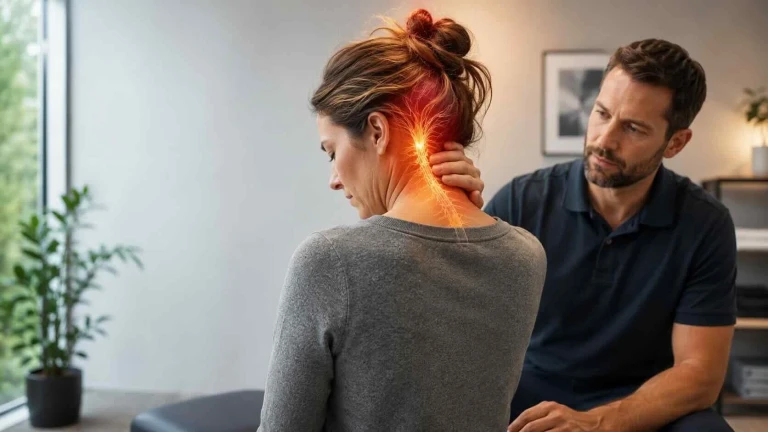
A sudden electric shock at the base of the skull. A stabbing sensation that travels upward through the scalp. Pain so sensitive that brushing your hair or turning your neck can trigger another burst.
Occipital neuralgia is not simply another headache. It is a nerve-pain condition involving the occipital nerves, which carry sensation from the upper neck into the back and top of the head. The pain is often severe, sharp, shooting, or stabbing, and attacks may last from seconds to minutes.
By downloading the Digital Patient Chart mobile app you can better control your patient portal.


For patients in Carson and across the South Bay, recurring pain at the back of the head deserves a careful evaluation—especially when it follows a neck injury, car accident, fall, or years of unresolved tension.
What Does Occipital Neuralgia Feel Like?
Occipital neuralgia usually begins near the base of the skull and travels upward along one or both sides of the scalp. The pain may reach the top of the head or extend toward the forehead and behind the eye.
Common symptoms include electric-shock-like pain, burning or aching at the back of the head, tenderness where the skull meets the neck, scalp sensitivity, and pain triggered by neck movement.
Because these symptoms can overlap with migraine, tension headache, and cervicogenic headache, diagnosis should not be based on location alone. A healthcare provider may use the symptom pattern, examination, imaging when appropriate, and sometimes an occipital nerve block to clarify the diagnosis.
Why Can a Problem in the Upper Neck Affect the Scalp?
The greater occipital nerves arise from the upper cervical region and travel through muscles at the back of the neck before entering the scalp. This creates a close relationship between the nerves, the upper cervical spine, and the muscles that control head position.
When tissues around these nerves become irritated, compressed, inflamed, or excessively tight, pain signals may travel upward into the head. Contributors can include trauma, tight muscles, repetitive strain, arthritis, or other neurological conditions.
That does not mean every case begins with an atlas misalignment, or that every sharp headache is occipital neuralgia. It does mean the upper neck should be examined rather than ignored.
The Overlooked Role of Past Neck Injuries
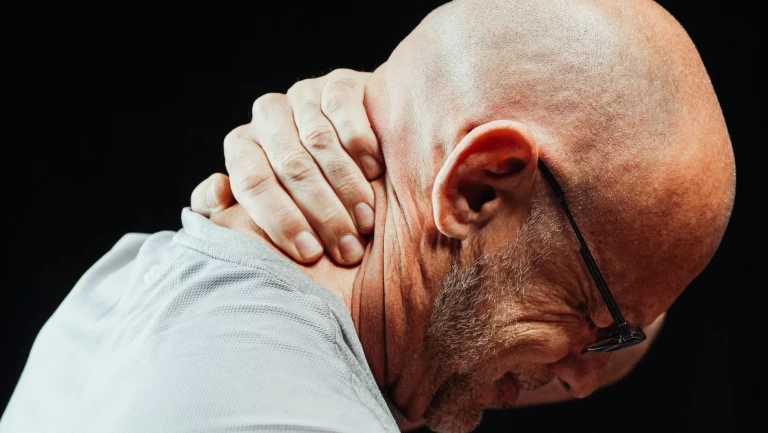
Occipital neuralgia may appear after a direct blow, whiplash injury, sports collision, or fall. Sometimes the relationship is obvious. Other times, it is not. Head or neck injuries are recognized potential causes of occipital nerve irritation.
A person may have been rear-ended on the 405 years ago, recovered from the initial stiffness, and later developed recurring pain at the base of the skull. Another may spend each day leaning toward a laptop, creating persistent tension in the suboccipital muscles.
Injury or repetitive strain can change how the head balances over the neck and how the surrounding muscles respond. When those muscles remain guarded, the occipital nerves may face ongoing irritation.
How Is Occipital Neuralgia Treated?
Treatment depends on the cause and severity. Conservative medical care may include heat, massage, physical therapy, medication, and activity changes. Persistent cases may be treated with injections or occipital nerve blocks. Surgery is generally reserved for selected cases that do not respond to less invasive care.
Upper cervical chiropractic care may be considered as one part of a conservative plan when examination suggests that restricted motion, postural imbalance, or muscular tension is contributing.
Evidence does not support presenting chiropractic care as a guaranteed cure for occipital neuralgia. Responsible care includes referring patients for medical or neurological evaluation when their symptoms suggest another cause.
What Makes Blair Upper Cervical Care Different?
Upper Cervical Health Care of Carson focuses on the atlas and axis—the C1 and C2 vertebrae directly beneath the skull. Dr. Jerome Ri uses the Blair Upper Cervical technique, a precise approach designed to evaluate the individual structure of the upper neck.
The process begins with a detailed history:
Where does the pain start?
How does it travel?
Which movements trigger it?
Is the scalp sensitive?
Did the symptoms begin after an accident, fall, sports injury, or other trauma?
When clinically appropriate, CBCT 3D imaging may be used to study the relationship between the skull, atlas, and axis. Any correction is based on the patient’s anatomy rather than a standard adjustment applied to everyone.
The Blair technique does not rely on forceful twisting, pulling, or popping of the neck.
The goal is not to chase the painful spot on the scalp. It is to determine whether an upper-neck problem is contributing to the irritation and whether improving cervical mechanics may reduce stress on surrounding tissues.
When Should Head Pain Be Treated as an Emergency?
Seek immediate medical attention for a sudden “worst headache of your life,” pain that reaches maximum intensity within seconds, or a headache accompanied by weakness, numbness, confusion, fainting, fever, a stiff neck, seizures, speech difficulty, loss of balance, or vision changes.
Head pain following a significant injury also requires prompt medical assessment.
An upper cervical consultation is not a substitute for emergency or neurological care. The first priority is ruling out dangerous causes.
Is an Upper Cervical Evaluation Right for You?

An evaluation may be reasonable when pain repeatedly begins at the base of the skull, travels into the scalp, worsens with neck movement, or develops after a head or neck injury.
It may also be worth considering when migraine-focused treatment has not fully explained a sharp, nerve-like pain pattern.
Upper Cervical Health Care of Carson serves patients from Carson, Torrance, Long Beach, Compton, Harbor City, and surrounding South Bay communities. The office is located at:
550 Carson Plaza Drive, Suite 122
Carson, California 90746
Phone: (310) 324-6172
Occipital neuralgia can make sleeping, driving, working at a computer, or washing your hair feel threatening.
The next step is not guessing which headache label fits. It is getting an evaluation that considers the nerves, the upper cervical spine, your injury history, and the warning signs that require medical referral.
Frequently Asked Questions
1. Can occipital neuralgia cause pain behind the eye?
Yes. Although the occipital nerves primarily supply the back and top of the head, pain may travel forward toward the forehead or behind an eye.
2.Is occipital neuralgia the same as migraine?
No. They are different conditions, although their symptoms can overlap. Some patients may experience both conditions.
3. Can a car accident trigger occipital neuralgia?
A head or neck injury, including a whiplash injury, can irritate the occipital nerves or the surrounding muscles and tissues.
Can upper cervical chiropractic cure occipital neuralgia?
No treatment should be presented as a guaranteed cure. Upper cervical care may be considered when neck mechanics contribute to the symptoms, but care should be individualized and coordinated with appropriate medical evaluation.
Leave a comment