

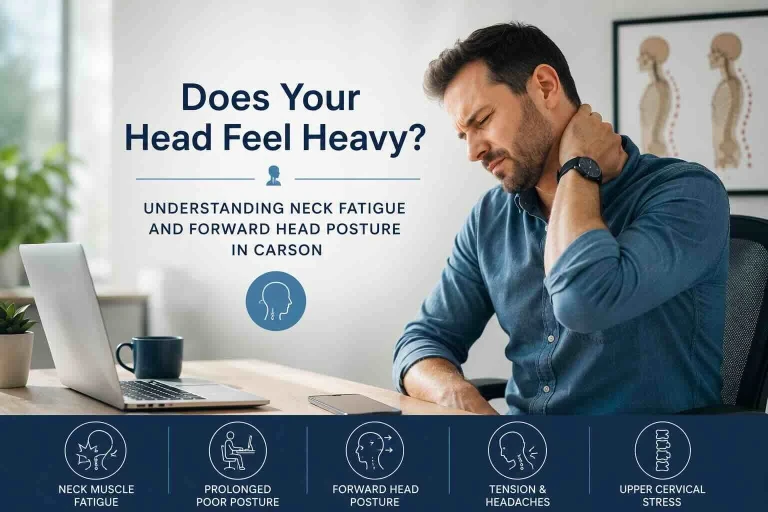
Your head does not actually become heavier at four o’clock in the afternoon.
It only feels that way.
By downloading the Digital Patient Chart mobile app you can better control your patient portal.


By the end of a commute on the 405, a shift spent looking at screens, or an evening scrolling on the couch, your chin has drifted forward. The muscles under the base of your skull feel packed tight. Your shoulders rise as if they are trying to help hold everything together.
You rub your neck. You sit up straighter. Ten minutes later, the heaviness is back.
The Direct Answer
A heavy-head sensation may develop when neck muscles fatigue from prolonged posture, joint irritation, stress, poor sleep positioning, an old injury, or a cervical spine disorder.
Forward head posture is often part of the pattern, but posture is not the only possible cause. Persistent heaviness—especially when accompanied by headaches, dizziness, arm symptoms, weakness, or difficulty holding the head upright—deserves a professional evaluation.
What Does “My Head Feels Heavy” Mean?
Patients use this phrase to describe several experiences:
- The neck tires quickly.
- The head feels difficult to hold upright.
- Pressure builds at the base of the skull.
- The shoulders and upper back begin burning.
- The person repeatedly props up the chin.
- Headaches appear after computer or phone use.
- The neck feels better when lying down.
- The head drifts forward again despite attempts to correct posture.
This is a symptom description, not a diagnosis.
In many cases, muscles are working harder than usual because the head is positioned forward relative to the torso. In other cases, pain, arthritis, whiplash, nerve irritation, or another condition changes how the person holds the head.
What Is Forward Head Posture?
Forward head posture occurs when the head rests in front of the shoulders rather than being comfortably balanced over the torso.
The upper neck often extends while the lower neck bends forward. Muscles near the skull remain active to keep the eyes level. The shoulders may round, and the upper back may become more curved.
Adults with neck pain tend to show more forward head posture than adults without neck pain, although age and other factors influence the relationship. Posture is therefore one part of the clinical picture—not proof of a single cause.

Why Modern Life Encourages the Pattern
Forward head positioning is not limited to office workers.
It can develop during:
- Phone and tablet use
- Laptop work
- Driving in traffic
- Gaming
- Sewing or detailed handwork
- Warehouse or production tasks
- Studying
- Salon work
- Long periods of reading
- Caring for a baby
- Sleeping with the head pushed too far forward
The problem is often less about one “bad” posture and more about remaining in the same posture for too long.
Your body is designed to move. Even an ideal-looking position can become uncomfortable when held without variation for several hours.
The Upper Cervical Connection
The atlas and axis sit directly beneath the skull. This region contributes to head positioning and a large portion of cervical rotation.
When the head moves forward, the upper cervical muscles may remain shortened and active to keep the face and eyes directed ahead. The lower cervical and upper thoracic regions may compensate in the opposite direction.
Over time, a patient may notice:
- Tight suboccipital muscles
- Headaches near the skull base
- Reduced neck rotation
- One shoulder sitting higher
- Jaw tension
- Tenderness where the neck meets the skull
- A feeling that posture “falls apart” quickly
An upper cervical examination asks whether the top of the neck is moving and loading normally within this larger pattern.
It does not assume that every postural change is caused by an atlas misalignment.
Posture Is More Than “Standing Up Straight”
People with neck fatigue are often told to pull their shoulders back and tuck their chin. They hold that rigid position until another set of muscles becomes tired.
Related article

TMJ Disorders & Upper Cervical Chiropractic: How Neck Misalignment Affects Jaw Function
Feb 02, 2025Useful posture is not a military pose. It is an adaptable position that allows breathing, movement, and frequent variation.
A complete strategy may include:
- Adjusting screen height
- Improving chair and desk setup
- Moving more often
- Strengthening cervical and shoulder muscles
- Restoring comfortable joint motion
- Reviewing sleep posture
- Addressing visual or vestibular problems when present
- Reducing habits that repeatedly provoke symptoms
Research suggests that targeted therapeutic exercise can improve forward head posture measurements and may reduce neck pain. Exercise selection should match the individual rather than relying on a universal social-media routine.
When a Heavy Head Is Not Just Posture
Arrange a medical evaluation when the sensation is persistent, progressive, or accompanied by neurological symptoms.
Important warning signs include:
- New arm or hand weakness
- Increasing numbness
- Dropping objects
- Loss of fine motor control
- Trouble buttoning clothing
- Balance or walking difficulty
- Electric-shock sensations with neck movement
- Severe pain following trauma
- Fever
- Unexplained weight loss
- Difficulty swallowing
- Inability to hold the head upright
Hand clumsiness, weakness, and balance changes may occur when the spinal cord is compressed in the neck and should not be treated as ordinary “tech neck.”
What an Upper Cervical Evaluation Looks For
Upper Cervical Health Care of Carson focuses on the atlas and axis using the Blair Upper Cervical technique. The office states that the technique does not use forceful pulling, popping, or twisting. Dr. Jerome Ri also uses detailed structural analysis and may use CBCT imaging when clinically appropriate.
An evaluation may include:
- Previous accidents, concussions, falls, and sports injuries
- Workstation and driving habits
- Head and shoulder position
- Cervical range of motion
- Muscle tone and tenderness
- Neurological screening
- Balance and postural findings
- Structural imaging when indicated
Imaging does not prove that posture is causing pain. It can, however, provide information about anatomy, joint relationships, degeneration, or other structural considerations that affect clinical decision-making.
Does the Adjustment Crack the Neck?
Related article

Balancing Your Body: The Transformative Power of Upper Cervical Chiropractic for Your Posture
Jan 19, 2025The Blair approach is designed to use a specific direction based on the patient’s anatomy and examination findings. It does not depend on broadly twisting the neck to produce a popping sound.
Not every visit necessarily requires another correction. The doctor may first check whether the previous correction appears to be holding and whether the patient’s postural findings are changing.
For a patient who already feels guarded or exhausted through the neck, a measured approach can be preferable to repeatedly forcing movement.
Daily Steps That May Reduce Neck Fatigue
Raise your phone rather than continually dropping your head toward it. Bring the monitor closer, and increase text size if you lean forward to read.
During long drives, sit close enough to the steering wheel that you are not reaching with the shoulders. Let the headrest support a neutral position rather than sitting several inches behind your head.
Change position every 30 to 60 minutes when possible. A short walk or a few comfortable movements can be more useful than trying to hold one “perfect” pose for the entire day.
Do not force aggressive chin tucks if they trigger dizziness, arm tingling, sharp pain, or pressure.
Frequently Asked Questions
1. Why does my head feel too heavy for my neck?
Muscle fatigue, forward head positioning, joint irritation, poor sleep support, stress, injury, or a cervical disorder may contribute. Persistent symptoms require evaluation rather than self-diagnosis.
2. Can phone use cause neck pain?
Long periods looking downward or holding the head forward can strain muscles and aggravate neck symptoms. Duration, movement habits, previous injuries, and physical conditioning also matter.
3. Can forward head posture be improved?
Many people can improve postural endurance and comfort through ergonomic changes, exercise, movement, and treatment of relevant mechanical problems. Structural changes and individual health factors influence the result.
4. Is forward head posture always caused by C1?
No. Forward head posture has multiple possible contributors. An upper cervical assessment evaluates whether C1 or C2 mechanics are part of the pattern; it should not presume they are the only cause.
5. Can a heavy head feeling come from a pinched nerve?
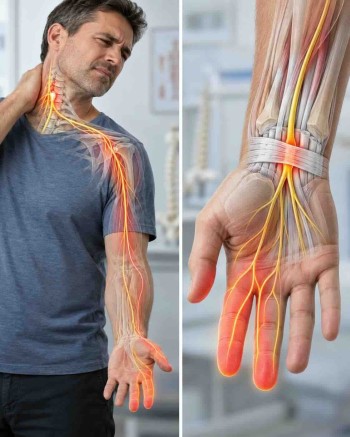
Nerve-root irritation more often causes radiating arm pain, tingling, numbness, or weakness. A neurological examination can help determine whether nerve involvement is present.
Upper Cervical Evaluation in Carson and the South Bay
A tired neck can slowly shrink a person’s day. Work becomes harder. Driving becomes irritating. Exercise ends early. By evening, lying down feels like the only way to give the head and shoulders a break.
Upper Cervical Health Care of Carson is located at 550 Carson Plaza Drive, Suite 122, Carson, California, serving Carson, Torrance, Long Beach, Harbor City, Compton, and surrounding South Bay communities.
Call (310) 324-6172 to schedule an evaluation with Dr. Jerome Ri and determine whether upper cervical mechanics are contributing to your neck fatigue or postural compensation.


Leave a comment