

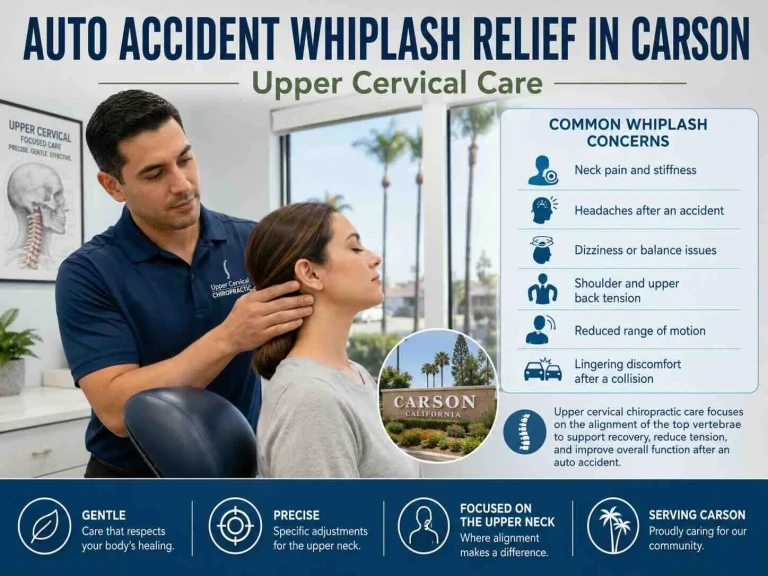
Car accidents happen fast. One moment you are stopped at a light on Avalon Boulevard or merging onto the 405, and the next there is an impact, a jolt, and a strange stillness where everything feels okay — until it does not.
The pain shows up hours later, sometimes the next morning. The stiffness sets in. The headaches start. And the medical system, after confirming nothing is broken, sends you home with muscle relaxants and a recommendation to rest.
By downloading the Digital Patient Chart mobile app you can better control your patient portal.


For a lot of accident victims in Carson and the South Bay, that is where the real problem begins. Not the accident itself, but everything that follows when the underlying structural injury goes undetected and untreated.
At Carson Chiropractic Office on Carson Plaza Drive, whiplash and auto accident injuries are evaluated and treated with a level of structural precision that standard post-accident care rarely provides — because the injury that matters most in a whiplash event is often the one that never shows up on a routine emergency room X-ray.
What Whiplash Actually Does to the Upper Cervical Spine
Whiplash is a soft tissue injury caused by rapid acceleration-deceleration of the head and neck. In a rear-end collision, the torso is pushed forward by the impact while the head momentarily lags behind, then snaps forward. That sequence happens faster than the surrounding muscles can react — typically in under 300 milliseconds — which means the cervical spine absorbs the force before any protective muscular response is possible.
The result is stretching and tearing of the cervical ligaments, muscle strain, and frequently, displacement of the atlas and axis vertebrae at the top of the spine. The atlas is particularly vulnerable.
As discussed, it has no intervertebral disc above it and no interlocking facets to limit movement. It is held in position primarily by soft tissue structures — the exact structures that whiplash overstretches and damages.
A displaced atlas following a whiplash injury is not a dramatic finding on standard imaging. It does not show up as a fracture or a gross dislocation. It is a precision misalignment — a rotation of a few degrees, a lateral shift of a millimeter or two — that standard cervical X-rays and MRI protocols are not calibrated to detect.
So the imaging comes back normal. The patient is told they are fine structurally. And the atlas sits in its displaced position, placing stress on the brainstem and disrupting the nervous system, for weeks, months, or years after the accident.
Related article

TMJ Disorders & Upper Cervical Chiropractic: How Neck Misalignment Affects Jaw Function
Feb 02, 2025Why Symptoms Are Often Delayed After a Car Accident
One of the most common and most misunderstood aspects of whiplash is the delayed onset of symptoms. Many accident victims feel relatively okay immediately after the collision. Adrenaline masks pain.
The muscular injury has not yet produced its full inflammatory response. The neurological effects of atlas displacement have not yet accumulated into recognizable symptoms.
By the next day or within the first week, the picture changes. Neck stiffness and soreness set in. Headaches develop, often concentrated at the base of the skull. Shoulder tension appears.
Some patients develop dizziness, difficulty concentrating, jaw pain, or upper back tightness that was not present before the accident.
These delayed symptoms are not psychosomatic. They are the predictable neurological and musculoskeletal consequences of an injury that was present from the moment of impact. The delay in symptom onset does not mean the injury is less real — it means the body was compensating, and compensation has limits.
The Carson and South Bay Context: High Traffic, Real Risk
Carson sits at one of the busiest freeway intersections in Los Angeles County. The 405 and the 110 converge nearby. Avalon Boulevard, Carson Street, and Sepulveda Boulevard carry significant daily traffic volume.
The combination of freeway merging, surface street congestion, and the stop-and-go patterns common to South Bay commuting creates consistent conditions for rear-end collisions.

Low-speed impacts are particularly deceptive. Research has shown that significant cervical soft tissue injury and atlas displacement can occur at collision speeds as low as five to eight miles per hour — well below the threshold where vehicle damage is visible.
Patients involved in minor fender-benders are sometimes dismissed from emergency care quickly because their car looks fine and they report feeling okay. Neither of those things rules out a meaningful structural injury to the upper cervical spine.
What Standard Post-Accident Care Misses
Emergency room protocols following an auto accident are designed to rule out life-threatening injuries: fractures, dislocations, internal bleeding. They are not designed to detect precision upper cervical misalignment.
A standard cervical spine series in an emergency setting looks for gross structural abnormality, not the millimeter-level rotational displacement that upper cervical care identifies and corrects.
Physical therapy and general chiropractic care address the muscular component of whiplash effectively. Soft tissue work, range of motion restoration, and strengthening all have their place in recovery. What they do not address is the atlas displacement sitting at the top of the structural chain — the foundational misalignment that the muscles are adapting and compensating around.
Working on everything downstream of an uncorrected atlas displacement produces temporary relief at best. The muscles will retighten. The headaches will return. The stiffness will cycle back. Because nothing has corrected the structural problem at the source.
How Carson Chiropractic Office Evaluates Whiplash Injuries
The evaluation begins with a detailed history of the accident — the direction of impact, the speed, whether you were braced or relaxed at the moment of collision, whether your head was turned, and the exact timeline of symptom onset. These details matter because they inform the likely pattern of atlas displacement.
Precision imaging follows. Cone beam CT or detailed upper cervical X-ray analysis produces a three-dimensional picture of the structural relationship between the skull, atlas, and axis. The degree of rotation, lateral displacement, and angular deviation are all measured objectively — providing data that emergency imaging never captures.
Related article

Temporomandibular Joint Disorders (TMD) and Upper Cervical Care: A Comprehensive Guide
Feb 16, 2024Objective neurological testing, including paraspinal infrared thermography and postural leg length analysis, gives additional information about how the nervous system is responding to the current structural state. A correction is only delivered when the objective findings support it. Not based on symptoms alone. Based on what the data shows.
The correction itself is gentle and precise. No twisting, no aggressive cervical manipulation, no audible pop. The force is low, the contact is specific, and the vector is calculated from the imaging. For patients whose soft tissues are still inflamed and whose nervous systems are under acute stress, this precision is not just preferable — it is the appropriate clinical standard.
What Recovery Looks Like
Whiplash recovery through upper cervical care is not a single adjustment and done. The soft tissues injured in the accident need time to heal. The atlas needs to hold its corrected position long enough for the surrounding musculature to adapt and stabilize. Follow-up objective testing at each visit confirms whether the correction is holding before any further adjustment is considered.
Most patients begin noticing meaningful improvement within the first few corrections — reduced headache frequency, improved neck range of motion, less shoulder tension, better sleep. The timeline varies based on the severity of the original injury, how long it went unaddressed, and individual healing factors.
What upper cervical care provides that other post-accident treatments do not is a correction of the structural foundation. When the atlas is restored to its proper position, the entire compensation pattern built around it begins to unwind — and the symptoms that seemed persistent and unrelated often resolve together.
Your Accident Was Real. Your Injury Deserves a Real Evaluation.
Insurance adjusters minimize. Emergency rooms rule out the catastrophic and send you home. The gap between those two responses is where a lot of Carson accident victims end up — told they are fine, feeling anything but, and unsure where to turn.
Upper cervical chiropractic fills that gap with objective data, structural precision, and a treatment approach designed for exactly the kind of injury a whiplash event produces.
Carson Chiropractic Office is located at 550 Carson Plaza Dr, Suite 122, Carson, CA 90746. Call (310) 324-6172 to schedule a post-accident evaluation.
The sooner the atlas displacement is identified and corrected, the better the recovery trajectory — and the less likely the injury is to become a chronic problem years down the road.


Leave a comment